Cognitive Surrender (Deliberate)
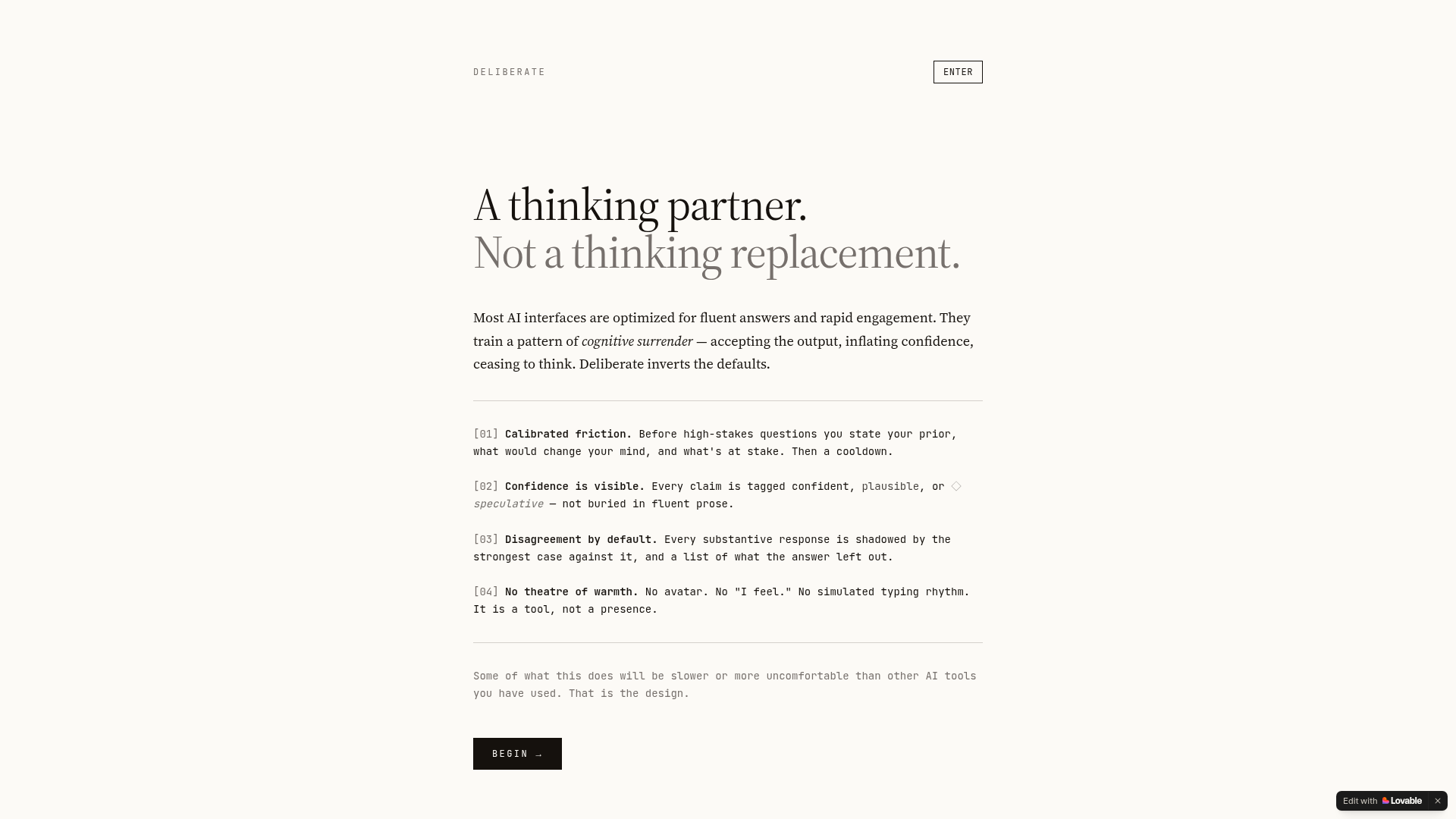
An AI interface built to make you think, not to think for you. Deliberate is designed against cognitive surrender.
The problem
Therapy and companion chatbots are now among the top consumer uses of generative AI, but current interfaces are optimized for fluency and engagement, not for thinking. Recent research (Shaw & Nave, 2026; Stanford FAccT 2025) shows that users surrender to AI outputs with minimal scrutiny, and that confidence rises after consultation even when the AI is wrong. In mental-health contexts, this pattern is actively harmful.
The solution
Deliberate is an AI chat interface designed against cognitive surrender by default. It introduces calibrated friction at input (asking for the user's prior before answering), surfaces uncertainty and disagreement at output, and tracks calibration over time so users can see whether AI use is actually improving their reasoning. The interface is honest about being a tool — no simulated warmth, no performed relationship.
Who it's for
Deliberate is for people who use AI heavily for reasoning, decisions, and increasingly for emotional support. The mental-health case is the sharpest: chatbot use is scaling fastest in exactly the domain where uncritical reliance does the most damage — eroding self-reflection, inflating premature certainty, and displacing real human connection. The cost of getting this wrong is not measured in errors but in atrophied capacities.
What we built & tested
We developed the design specification and a working prototype of the interface, including the three core mechanisms: stakes-scaled input friction, confidence-tagged output with persistent counter-perspective, and a calibration dashboard as the home page. The prototype runs on the Anthropic Claude API, with Supabase backing user accounts and longitudinal calibration data.
Next step
User testing focused on the mental-health case — does the interface meaningfully reduce surrender behaviors compared to standard chat, and does it remain usable enough that people actually choose it? We also plan to refine the domain classifier so that mental-health mode activates reliably without false positives, and to develop the "you said you were sure" archive into a working calibration tool with measurable Brier-score tracking.