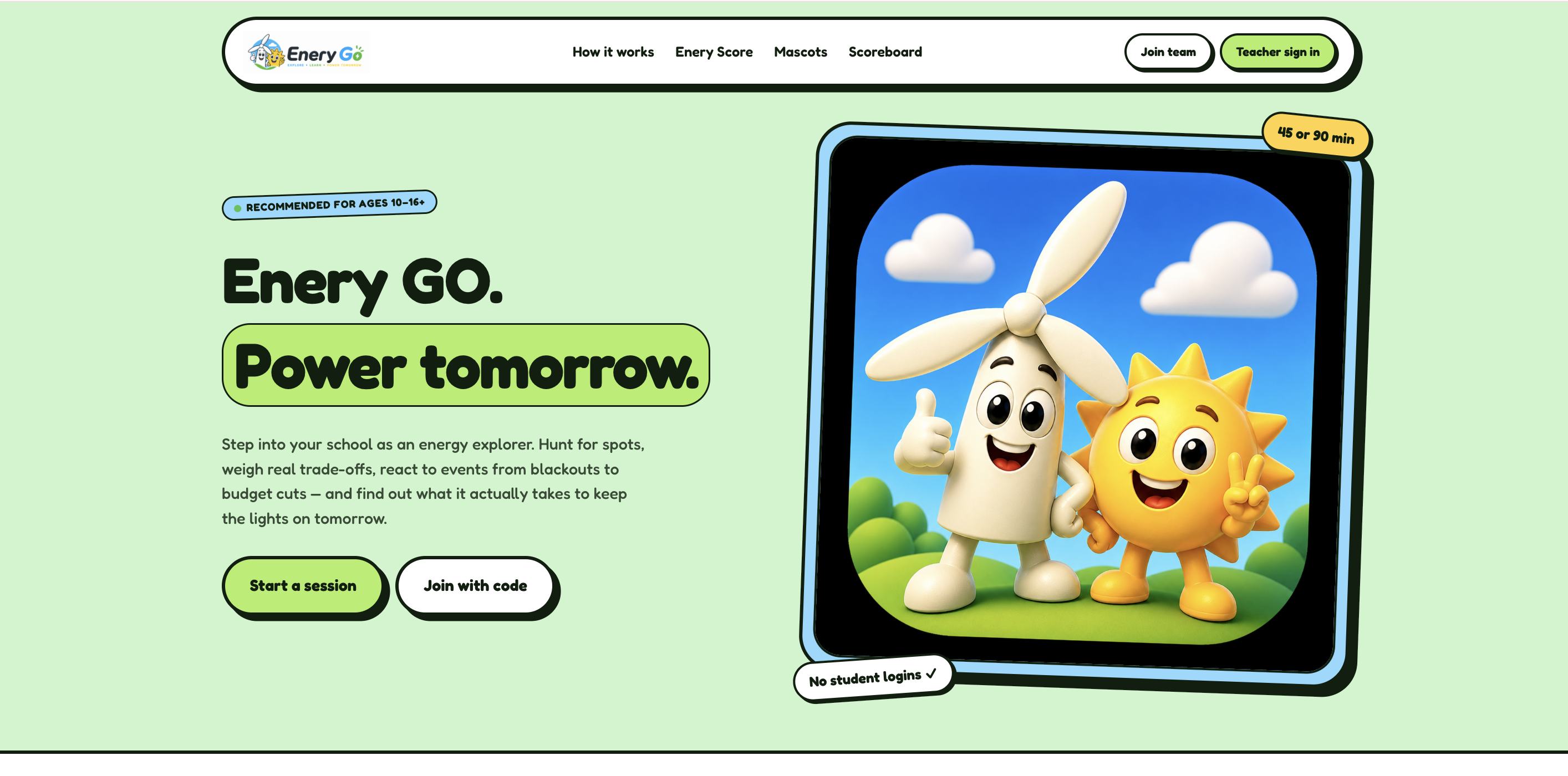
Enery Go – the brainrot game
Ready to start the Enery Go School Challenge? Explore your surroundings, collect energy opportunities, and use your findings to build the best renewable energy future in a live classroom simulation.
The problem
Students experience renewable energy as abstract and distant, especially in rural areas in Czechia. It’s often not strongly embedded in school curricula, and at home they may not hear about it or may even encounter skepticism. Teachers can also be hesitant to adopt new, more interactive formats. As a result, students lack a real understanding of how energy decisions work in their own environment.
The solution
A game-based learning experience that gets students out of the classroom and into their real surroundings. Using their phones, they go outside, take photos, and decide where solar panels, wind turbines, or efficiency solutions could be placed in their local area. These real-world inputs feed into a live simulation where they instantly see impacts on CO₂, cost, stability, and public acceptance.
Who it's for
For students aged 10-16+ and their teachers, with a strong focus on rural schools. It matters because it makes the energy transition local and tangible, especially in places where students may have less exposure to these topics. It helps them form their own informed opinions, beyond what they hear at home or in theory.
What we built & tested
We built a real clickable prototype that simulates the full classroom experience, from team onboarding to outdoor missions and live scoring. Students go outside with their phones, take pictures, and decide where to place solar panels and wind turbines in their own environment, turning learning into an active game.
To make it engaging and relatable for younger audiences, we introduced playful, slightly “brainrot-style” mascots (Sunino & Windmillino) that guide students through missions, explain concepts, and react to their decisions. This adds humor, personality, and keeps attention high.
Next step
Pilot the MVP in different schools, including rural areas in Czechia, to test usability and engagement, especially the outdoor missions. We will also collaborate with youth councils to gather feedback from students and refine the experience to make it simple and appealing for teachers to adopt.